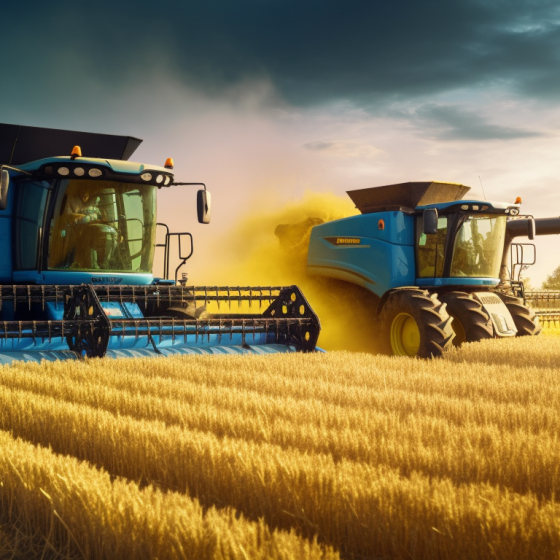
Agriculture as a Key Economic Driver
In 2025, agriculture continues to play a central role in the Ukrainian economy, generating a significant share of foreign exchange earnings. Grain, oilseeds, and sunflower oil remain the core export products, ensuring supplies to the EU, North Africa, the Middle East, and Southeast Asia.
According to USDA/FAS estimates, corn exports in the 2024/25 marketing year reached about 22 million tons, with ~19.1 million tons shipped between October and June alone. Despite logistical challenges, Ukraine retains its position among the top agricultural suppliers worldwide.
However, war-related risks and declining harvests have impacted exports. In June 2025, the Minister of Agrarian Policy forecasted a 10% reduction in grain production compared to 2024. Exports of sunflower oil dropped by nearly 25% year-on-year due to smaller harvests and logistics constraints.
Shifting Geographies and Trade Rules
While demand for Ukrainian products remains strong, export destinations are changing.
-
Part of the volumes have been redirected to North Africa, the Middle East, and Asia due to EU quotas and tariffs.
-
A preliminary EU-Ukraine trade agreement on agriculture aims to balance Ukrainian access to European markets while protecting EU farmers.
This new regulatory framework will define the rules of agricultural exports in the coming years, requiring Ukrainian producers to adapt strategically.
Logistics Under Wartime Pressure
Logistics remains one of the biggest challenges for Ukrainian exporters:
-
Seaports: From January to June 2025, seaports processed 40+ million tons of cargo, including 20.3 million tons of grain. Since reopening, the maritime corridor has carried 120+ million tons of cargo — 76 million tons of which were agricultural.
-
Solidarity Lanes: Around 20% of agri-food exports are transported through rail, road, and river routes to the EU. These alternatives are crucial when ports are under attack.
-
Security risks: In March 2025, a missile strike on a grain ship in Odesa killed four people, underlining the constant dangers and increased insurance costs faced by exporters.
Potential of Domestic Processing
Ukraine is actively shifting towards value-added processing to reduce reliance on raw material exports:
-
Oilseed processing plants are currently running at ~65% capacity, leaving significant room for expansion.
-
The government is promoting policies to limit raw exports and stimulate crushing, milling, and refining inside the country.
-
According to Kyiv School of Economics, the food industry has the capacity to scale if investments in modernization and certification are secured.
USDA forecasts for 2025/26 show that more oilseed crops will be directed to domestic processing, boosting production of meal, packaged oil, and feed products for export with higher margins.
Main Obstacles to Growth
Despite strong potential, Ukraine’s agro-processing industry faces several systemic challenges:
-
Financing gap
-
SMEs lack access to long-term affordable loans.
-
Of UAH 10.9 billion in state agricultural support, only UAH 1.36 billion is allocated to processing grants — not enough for large-scale upgrades.
-
-
Certification & standards
-
International HACCP and EU packaging standards are mandatory for exports.
-
The July 2025 decision to impose a 10% export duty on rapeseed and soybeans was meant to boost processing but created bottlenecks due to unclear certification rules.
-
-
Energy instability
-
Russia’s missile and drone attacks in 2025 caused widespread blackouts.
-
Power plants often run at less than 10 GW, versus the pre-war norm of 37 GW.
-
The energy sector requires billions in investment for restoration, directly affecting processing capacity.
-
Outlook: From Grain Powerhouse to Processing Hub
Ukraine’s agricultural sector is undergoing a strategic transformation:
-
Exports remain strong, but regulatory shifts and war logistics are reshaping markets.
-
Domestic processing offers the chance to capture higher margins, create jobs, and strengthen resilience.
-
International investment, credit lines, and green modernization (backed by OECD, UNIDO, World Bank programs) will be decisive in scaling Ukraine’s food industry.
With the right policies and financial instruments, Ukraine can turn its agriculture from raw export dependency to a high-value processing hub, reinforcing both economic stability and integration into the EU food supply chain.