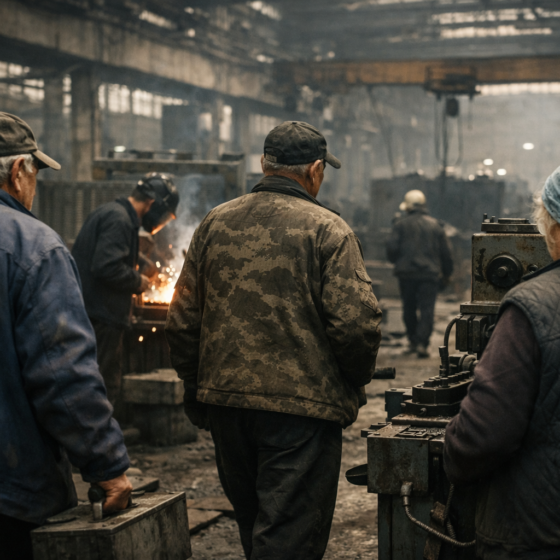
Executive summary. Ukraine's defense industrial base includes more than one hundred enterprises and has shifted from fragmented wartime adaptation to a scaled production model with stronger export orientation. Utilization has risen in ammunition, armored platforms, and unmanned systems, while order visibility improved through partner-country procurement channels.
Production capacity by segment
- Artillery and munitions: expansion in NATO-caliber output and higher line utilization.
- Armored systems: modernization and assembly throughput increased across core facilities.
- UAS segment: rapid scaling in reconnaissance and strike platforms with mixed public-private supplier base.
- ATGM and EW: selective growth tied to external procurement and interoperability demand.
Export licensing economics
Regulatory changes shortened licensing timelines for eligible destinations and improved approval predictability. For investors, this reduces working-capital friction and increases contract conversion rates, particularly in segments with repeat export demand.
Foreign financing integration
US and EU security financing envelopes continue to create baseline demand for systems manufactured in Ukraine or co-produced with partners. This supports multi-year order pipelines and strengthens planning assumptions for capacity investments.
Co-production and technology transfer
Partnerships with European and NATO-aligned manufacturers support licensed production, shared component chains, and royalty-bearing technology transfer. Bankability improves where legal IP frameworks, export control alignment, and delivery governance are explicit.
Corporatization and private capital
State-enterprise reform and corporatization pathways are opening room for private participation. Venture and strategic capital remain concentrated in drones, electronics, counter-UAS solutions, and dual-use subsystems.
NATO standards pathway
STANAG alignment in ammunition, communications, and logistics data exchange is now a direct valuation factor. Firms with compliance traceability and certified processes are better positioned for long-duration partner contracts.
Investor implications
Defense manufacturing in Ukraine is a high-opportunity, high-execution market. Core drivers are licensing speed, standards compliance, supply-chain resilience, and disciplined contract performance under export control constraints.