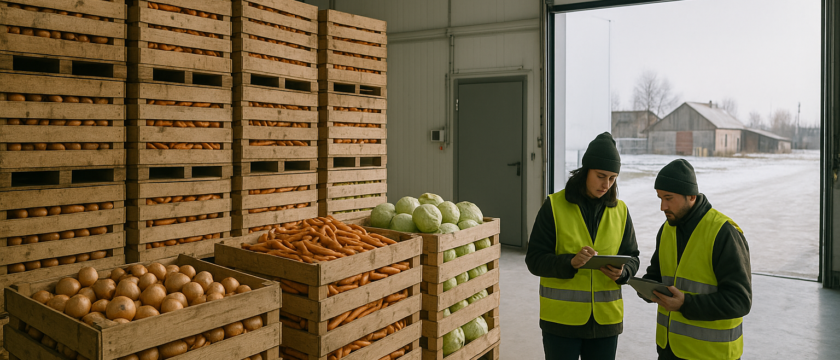
Ukraine has for the first time provided targeted state backed financing for the construction of a modern vegetable storage facility. The project will allow a producer to store vegetables in controlled conditions instead of selling them immediately after harvest or losing part of the crop to spoilage.
For investors this is more than a single deal. It is an early signal that public financial institutions are ready to co finance basic agrifood infrastructure – cold storage, logistics and processing – rather than focusing only on field production and large export terminals.
Why vegetable storage matters for the investment story
The absence of modern storage has long been one of the weak links in Ukrainian agriculture. Farmers were forced to sell quickly after harvest, when prices were lowest, while retailers and processors depended on imports in the off season. This undermined margins along the entire value chain.
A properly financed vegetable storage facility changes the economics in several ways:
- reduces post harvest losses and stabilises quality over the season;
- smooths price volatility between harvest and late winter;
- allows producers to negotiate longer contracts with retailers and processors;
- creates a physical base for future washing, packaging and light processing.
How the first financed project is structured
According to the publication, the pilot project is supported by a state linked financial institution that provides long term funding for construction and equipment. The borrower is a Ukrainian agribusiness that specialises in vegetables and is ready to co invest its own capital.
The financing model combines several elements that are typical for development banking: longer loan tenor than commercial banks would normally offer, grace periods for construction, and conditions linked to energy efficiency and technological standards. If the project performs well, it can become a template for a series of similar transactions.
Replication potential across regions and crops
The logic of the project is easily replicable. Many regions grow vegetables, potatoes and fruit that could benefit from controlled storage, while local authorities are looking for ways to stabilise prices for consumers and support farm incomes.
For investors this opens several potential strategies:
- partnering with agribusinesses to co finance storage clusters in vegetable producing regions;
- adding renewable energy and energy efficient equipment to reduce operating costs of cold storage;
- building integrated hubs that combine storage with sorting, packaging and distribution;
- structuring portfolios of similar assets that can be refinanced on the capital markets over time.
What this says about Ukraine’s agrifood trajectory
Ukraine’s brand in global markets has traditionally been linked to bulk crops and raw commodities. The first state backed financing for a vegetable storage facility signals a gradual shift towards more managed, infrastructure based food systems.
If this approach is scaled, the country can move up the value chain without abandoning its role as a major producer. For long term capital this combination of primary production, basic processing and logistics infrastructure offers a diversified way to participate in Ukraine’s food security and export story.