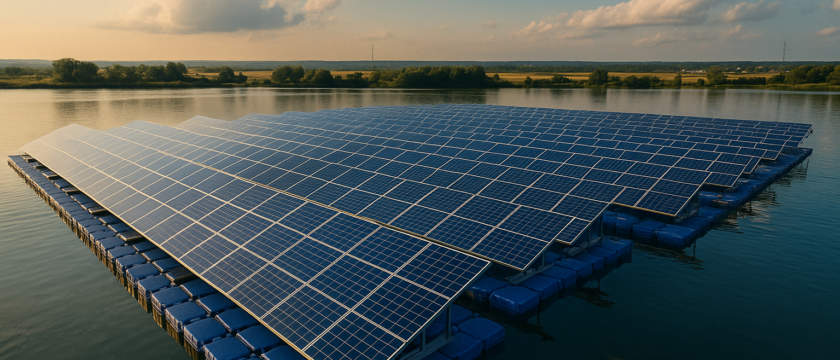
Ukraine’s first floating solar (FPV) project has been launched in the Odesa region, marking a new phase in distributed, land-light generation. Deployed on a water body, the plant uses raft-mounted PV arrays with anchoring and mooring systems—freeing scarce land, shortening construction windows, and improving energy output through natural panel cooling.
Why It Matters for Investors
-
Resilience & speed: FPV can be rapidly installed on existing reservoirs with minimal civil works—valuable under wartime constraints and grid repair cycles.
-
Higher yield: Cooling and reflected light typically lift FPV output by ~5–10% versus ground-mount PV in similar irradiance conditions.
-
No land take: Avoids land acquisition, permits dual use of water assets, and reduces conflicts with agriculture or reconstruction priorities.
-
Water benefits: Arrays can cut surface evaporation and may lower algae growth, supporting irrigation and municipal uses.
Site & Technology Snapshot
-
Location: Reservoir or industrial basin within the Odesa region (final siting dictates anchoring, cable routing, and interconnection).
-
Design: Modular floats with framed modules, DC cabling in UV-stable conduits, string inverters on floats or onshore pads, and flexible power umbilicals to shore.
-
Grid tie-in: Medium-voltage export to the nearest substation; potential co-location with battery storage to manage evening ramps and curtailment risk.
Commercial Model Options
-
Private PPA: Direct offtake with municipal utilities, water utilities, or industrial loads (waterworks, ports, food processing).
-
Behind-the-meter: Reservoir owner or utility self-consumes power, reducing retail tariffs and losses.
-
Blended finance: Use of guarantees, political/war-risk cover, and concessional debt to compress WACC and hedge construction risk.
Regulatory & Permitting Considerations
-
Water authority approvals: Surface-use rights, anchoring, navigation corridors, and drawdown envelopes.
-
Environmental review: Aquatic biodiversity, fisheries access, sediment and bird-flight assessment; exclusion zones and seasonal work windows.
-
Grid access: Connection agreement, metering, reactive power provision, and curtailment clauses; consider storage to meet dispatchability rules.
-
Health & safety: Float integrity, walkways, anti-slip surfaces, life-saving equipment, and electrical isolation procedures.
Engineering Risks & Mitigants
-
Wind, waves, and storms: Use site-specific metocean and ice-load studies; multi-point mooring, wave-attenuation fences in fetch-exposed sites.
-
Biofouling and corrosion: Marine-grade materials, sacrificial anodes, and scheduled cleaning.
-
Seasonal icing: Reinforced floats, ice-compatible moorings, and winter operating procedures; select sheltered basins where possible.
-
Cable management: Floating or bottom-laid umbilicals with slack for water-level variation; strain-relief joints and inspection routines.
Economics at a Glance (Illustrative)
-
Capex: FPV typically +5–15% vs. ground-mount due to floats, moorings, and marine-grade balance-of-system—partly offset by reduced earthworks and land costs.
-
Yield: +5–10% energy gain from cooling and albedo; capacity factor in southern Ukraine commonly ~15–18%, site-dependent.
-
Opex: Slightly higher for water-based cleaning/inspection; mitigated by modular access platforms and preventive maintenance.
Strategic Fit for Ukraine
-
Distributed generation: Places capacity close to loads (waterworks, cities), easing transmission constraints while larger grid assets are repaired.
-
Scalability: Reservoirs, irrigation ponds, settling basins, and quarry lakes offer replication potential across multiple oblasts.
-
Dual-use infrastructure: Supports water security and energy independence simultaneously—key resilience goals.
FPV vs. Ground-Mount PV (Investor Comparison)
| Dimension | Floating PV (FPV) | Ground-Mount PV |
|---|---|---|
| Land use | No land take; preserves arable/reconstruction land | Requires land acquisition/lease |
| Build speed | Fast once permits secured; minimal earthworks | Fast, but site grading and fencing add time |
| Energy yield | Typically higher (+5–10%) | Baseline yield |
| Capex | +5–15% for floats/moorings | Lower BOS costs |
| Opex | Slightly higher (aquatic access, cleaning) | Lower, well-known routines |
| Environmental | Reduces evaporation, potential algae control | May face land-use conflicts |
| Risks | Wind/wave/ice loads; biofouling | Soil, dust, soiling, shading |
| Ideal offtakers | Water utilities, municipalities, industry near reservoirs | Utility-scale or agri-adjacent loads |
What to Watch Next
-
Exact site specs and capacity (MW), interconnection point, and construction schedule.
-
Offtake structure: Whether a municipal/utility PPA or behind-the-meter model is chosen.
-
Storage add-on: Battery sizing and revenue stack (peak shaving, firming, curtailment hedge).
-
Insurance & warranties: War-risk riders, weather perils, float and mooring warranties, inverter MTBF terms.
Outlook
The Odesa FPV project is a practical, scalable template for adding resilient generation where land is constrained and grid stability is paramount. If execution validates costs and yields, expect copy-and-paste deployments on reservoirs across the south and center—accelerating Ukraine’s shift to distributed, low-land-use renewables while the country rebuilds its energy system.