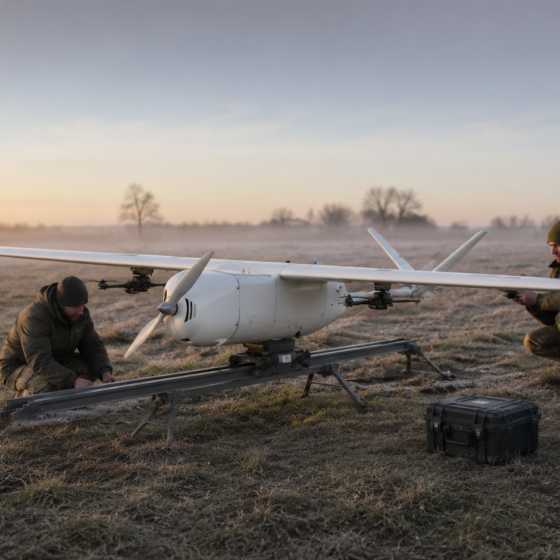
Ukrainian company Altair Technologies has developed a universal launcher for repeated takeoff of fixed-wing unmanned aircraft and other flying platforms. The catapult accelerates an aircraft along a guide rail using elastic traction, while an electric remote-release system controls the launch.
The launcher is a separate engineering product rather than a minor accessory. Its dimensions, tension, release mechanism and compatibility directly influence takeoff repeatability, crew safety and the range of aircraft that can operate without a runway.
Full-size launch configuration
In deployed form, the launcher is up to 4,900 millimeters long, 1,100 millimeters wide and 1,100 millimeters high. Its deployed mass does not exceed 52 kilograms. The long guide rail provides controlled acceleration for aircraft with a launch mass of up to 30 kilograms.
The system uses manual tensioning with a stated force from 150 to 190 kilograms. Elastic traction removes the need for a disposable rocket booster and allows the launcher to be prepared for repeated use after inspection and restoration of tension.
Electric remote release
The release is electric and remotely controlled. This allows the crew to move away from the rail before the aircraft begins accelerating and helps standardize the launch sequence compared with a purely manual trigger.
Remote release does not remove the need for safety procedures. Alignment, aircraft retention, rail condition, cable connections and the clear launch sector must be checked before every start.
Compact transport configuration
When folded, the launcher is no more than 1,780 millimeters long, 450 millimeters wide and 300 millimeters high. The compact package can be transported in a vehicle and stored without the space required by a permanently assembled rail.
A mass of up to 52 kilograms permits the launcher to be moved by a small crew in separate or folded sections. Actual deployment speed will depend on ground conditions, crew training, aircraft type and the preparation of a level launch position.
Operation in changing weather
The stated operating temperature range is from minus 25 to plus 35 degrees Celsius. This supports winter and summer use, but temperature affects elastic elements, batteries, lubricants, electrical connections and the mechanical behavior of the launch system.
Before launch, operators need to inspect the elastic traction, guide rail, fasteners, carriage and electric release. A reusable launcher gains economic value only when its wear can be measured and maintenance intervals are clearly defined.
Adaptation to different aircraft
The installation is designed for unmanned aircraft and universal flying platforms within the permitted mass. Altair Technologies also offers development of catapults with different complexity and configuration according to customer requirements.
Adaptation can involve rail geometry, carriage interface, tension force, aircraft retention, transport layout and remote-control logic. This allows the launcher to support a family of aircraft rather than remain tied permanently to one model.
Why launch infrastructure matters
A ground launcher determines deployment speed and takeoff consistency almost as much as the aircraft itself. It removes the need for a prepared runway, permits operations from dispersed sites and reduces dependence on an aircraft undercarriage capable of ground takeoff.
Standardized catapults can also separate aircraft and launcher manufacturing between specialized suppliers. Common mechanical and electrical interfaces make it easier to integrate new airframes and maintain equipment in the field.
Industrial and investment potential
For investors, launch equipment is part of the infrastructure of unmanned aviation. Demand grows not only with the number of UAV models but also with training centers, testing facilities, reserve units and the need to replace equipment after long use.
Scaling requires repeatable manufacturing, load testing with different aircraft masses and centers of gravity, documented service life for elastic components, spare-part supply and crew training. With those elements in place, Altair Technologies can provide customers with a complete aircraft system rather than only an airframe.