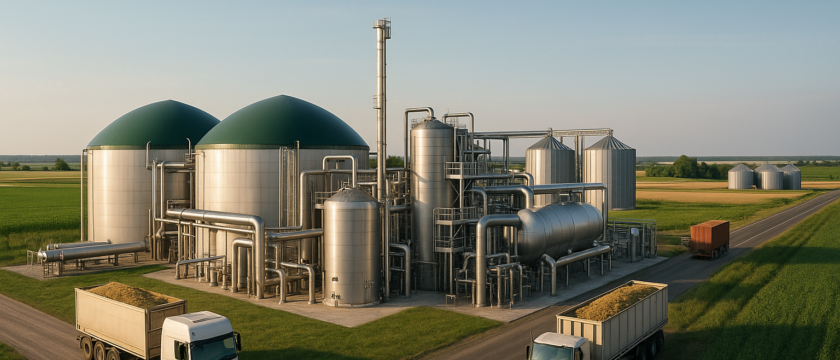
Ukraine is preparing a long-term Biomethane Production Development Program that will run until 2035 and make biomethane one of the country’s key energy resources. The draft government resolution, published by the Ministry of Economy, Environment and Agriculture, sets out a roadmap for replacing part of imported natural gas with domestically produced renewable gas from agricultural and livestock waste.
The initiative is directly linked to Ukraine’s commitments under the Association Agreement with the EU and to the European REPowerEU plan for scaling up renewable gases. For investors, this is a signal that biomethane is moving from pilot projects and isolated plants to a structured national program with clear production targets and regulatory changes.
From 41 million m³ today to 2.1 billion m³ by 2035
According to the explanatory note to the draft program, Ukraine produced around 41 million m³ of biomethane in 2024 at the first wave of biomethane plants. Several new facilities are expected to come online by the end of 2025, bringing annual output to about 111 million m³.
The government’s goals are significantly more ambitious in the medium and long term:
- By 2030: more than 1 billion m³ of biomethane per year.
- By 2035: around 2.1 billion m³ per year.
- Long-term potential: up to 5 billion m³ annually, based on available feedstock.
In the longer horizon, industry experts estimate that Ukraine’s resource base would allow even higher volumes if the right investment and grid-access conditions are in place.
Agricultural waste as a scalable feedstock
The program is built around Ukraine’s strong agricultural base. The main feedstock for biomethane will be residues and waste streams that are often underutilized today:
- Straw and post-harvest residues from grain and corn production.
- Manure and slurry from cattle and pig farms.
- Other organic waste from the livestock and food-processing sectors.
For agribusiness, biomethane plants offer a new revenue line and a way to manage waste in a more environmentally responsible manner. Digestate – the by-product of biomethane production – can be used as an organic fertilizer, closing the nutrient loop and reducing dependence on imported mineral fertilizers.
Key pillars of the biomethane program
The draft program combines infrastructure, regulation and international integration. Among its core elements are:
- New plants and modernization. Construction of new biomethane facilities and the upgrade of existing biogas plants so they can upgrade biogas to grid-quality biomethane.
- Legislative overhaul for renewable gases. Refining legislation and technical standards for biomethane production, grid injection and guarantees of origin.
- Removal of export barriers. Gradual elimination of excessive tax and regulatory burdens on biomethane exports.
- Investment incentives. State support mechanisms to de-risk capital-intensive projects, including access to international climate and reconstruction finance.
- Integration with the EU Union Database (UDB). Full connection to the European system for tracking renewable gases, which is critical for cross-border trade and certification.
Ukraine’s existing gas transmission system, capable of transporting up to 170 billion m³ of gas per year, is an important advantage. It allows biomethane produced in rural regions to be moved both to domestic consumers and, in the future, to EU markets.
Impact on energy security and climate commitments
The program’s strategic objective is to gradually replace a significant share of natural gas with domestically produced biomethane. This would:
- Reduce dependence on imported fossil gas and strengthen energy security.
- Cut greenhouse gas emissions in line with EU climate goals and Ukraine’s updated NDCs.
- Create new investment projects and jobs in the agricultural and energy sectors.
For investors, biomethane in Ukraine is increasingly a reconstruction story: projects that simultaneously support rural development, decarbonisation, export revenues and energy independence. If the program is approved and implemented as planned, biomethane could become one of the flagship segments of Ukraine’s green transition by 2035.